Nearly four years later, the vivid memory of my first visit to the collection at the Indian Arts Research Center (IARC) lives on in my mind’s eye. If I close my eyes, I can recall the incomparable yet indescribable feeling of being in the presence of so many beautiful pots—so many beautiful relatives. Anyone who has ever set foot within the vaults of the IARC can surely relate to this memory.
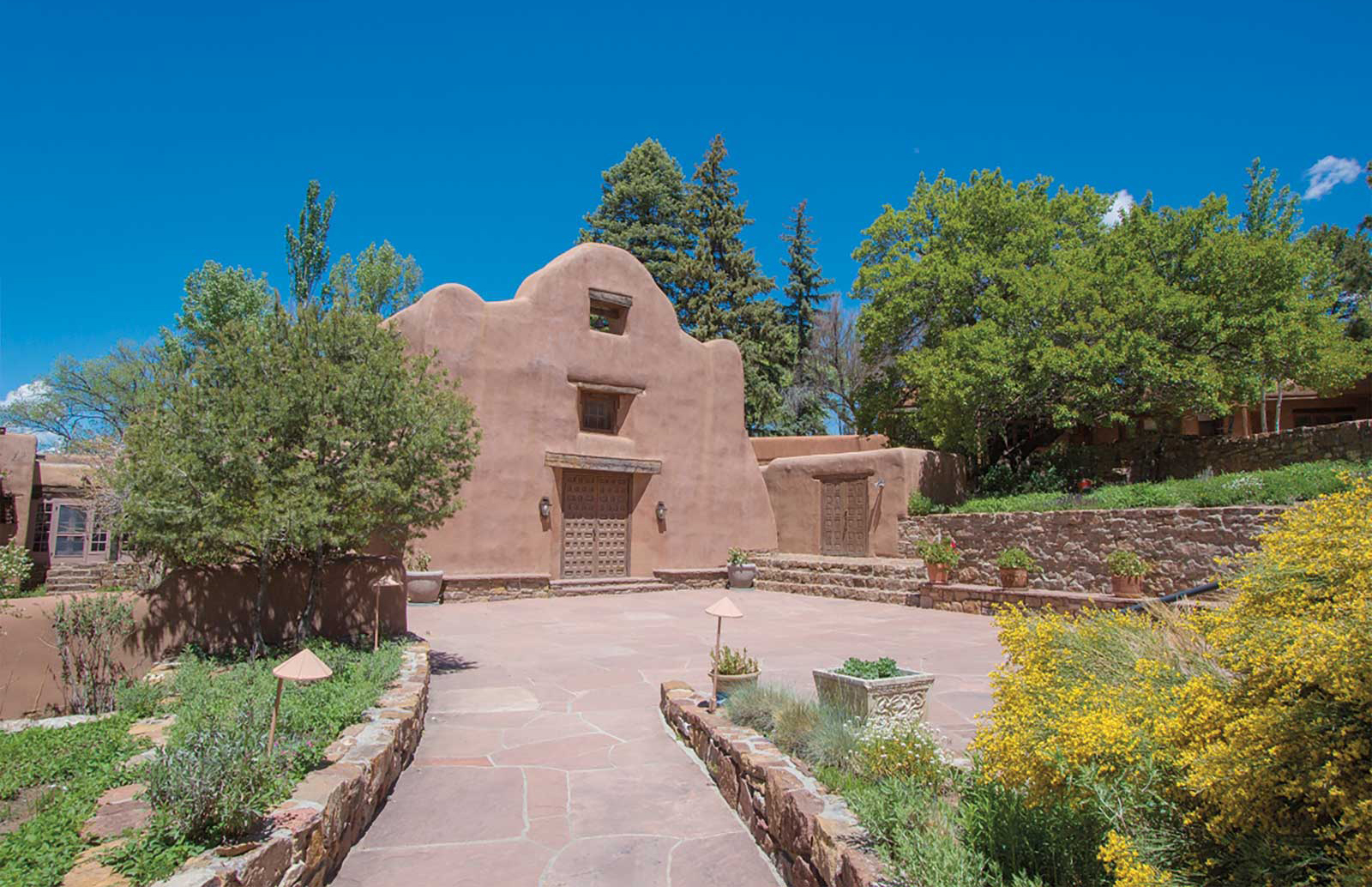 The School for Advanced Research in Santa Fe, New Mexico.
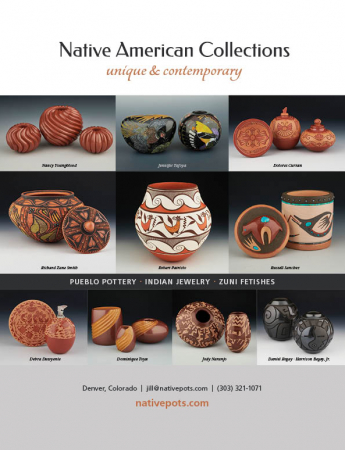
What sets the IARC apart from any museum is the open storage of the collection. The vaults are filled with rows and rows of shelves upon shelves of pottery—each item with a story and life of its own. With a collection of more than 12,000 items that span from the sixth century to the present, the IARC is primarily a research collection that serves as a resource for artists, scholars, researchers, students and others. For this reason, the IARC is non-exhibiting, which differs from many other institutions that steward Native American collections.
Until this year, anyone who has wanted to see the incredible works within the IARC has had to travel to the School for Advanced Research Campus (SAR) in Santa Fe, New Mexico. Of course, over the last few years many have traveled there virtually. However, on July 31, an exhibition organized by SAR and the Vilcek Foundation will open at the Museum of Indian Arts & Culture (MIAC) before traveling nationally in 2023.
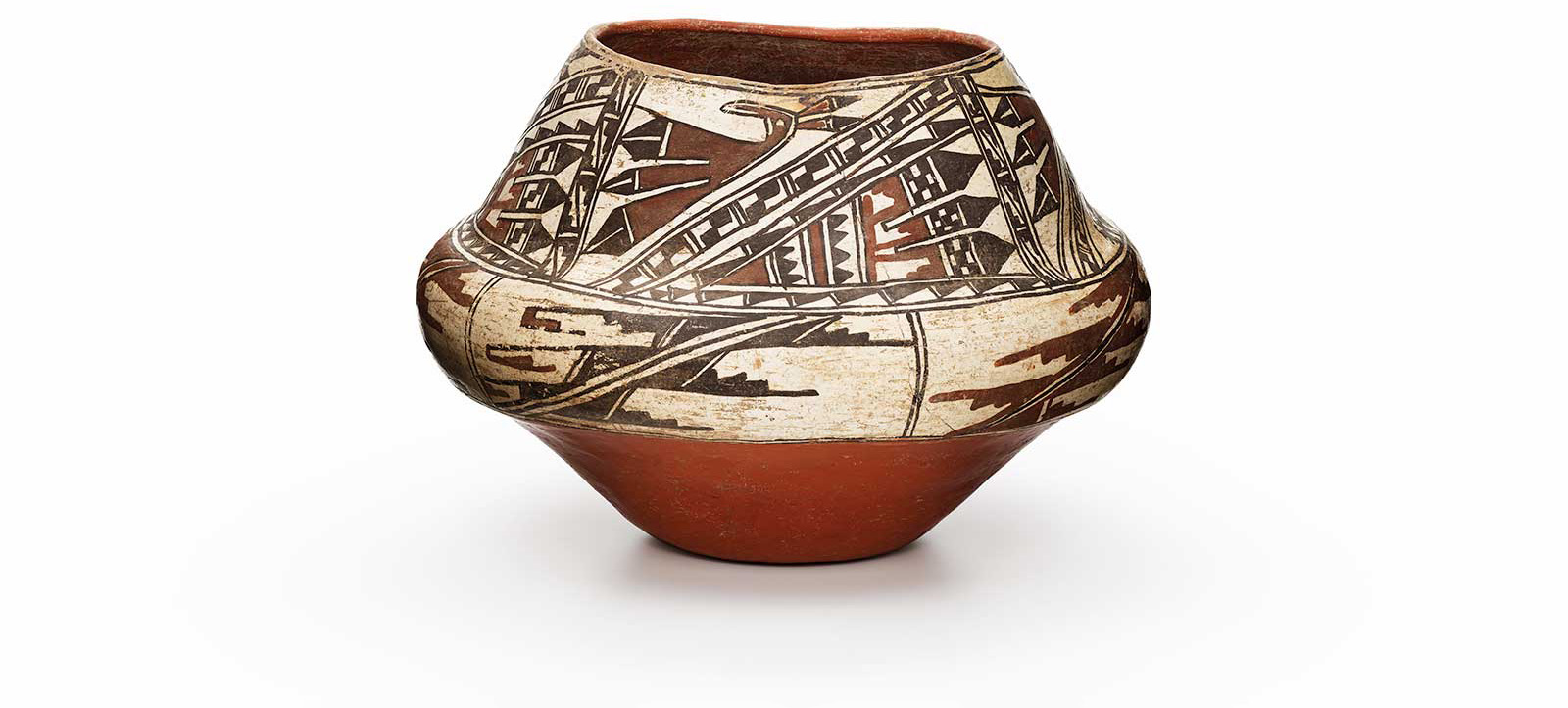 Halona:wa/Zuni Pueblo, K’yabokyade’ele (water jar), ca. 1720
Located on ancestral lands of the Tewa people in O’gah’poh geh Owingeh or Santa Fe, New Mexico, and nestled between what many now recognize as Canyon Road and Museum Hill, the Indian Arts Research Center is a division of SAR with a goal of “bridg[ing] the divide between creativity and scholarship by supporting initiatives and projects in Native American studies, art history, and creative expression that illuminate the intersections of the social sciences, humanities, and arts.” This exhibition does exactly that.
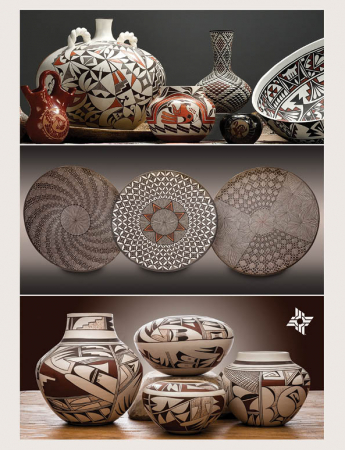
Grounded in Clay: The Spirit of Pueblo Pottery is a community-curated exhibition that will showcase more than 100 historic and contemporary works from two significant Pueblo pottery collections: the Indian Arts Research Center and the Vilcek Foundation of New York. The pots that will be featured in this first-of-its-kind exhibition were selected by the Pueblo Pottery Collective, a group of more than 60 individual members of 21 tribal communities. These individuals represent communities spanning from New Mexico’s 19 Río Grande Pueblos to the West Texas community of Ysleta del Sur and the Hopi tribe of Arizona. Representing diverse ages, backgrounds and professions, these curators selected and wrote about one or more works for the exhibition and accompanying catalog.
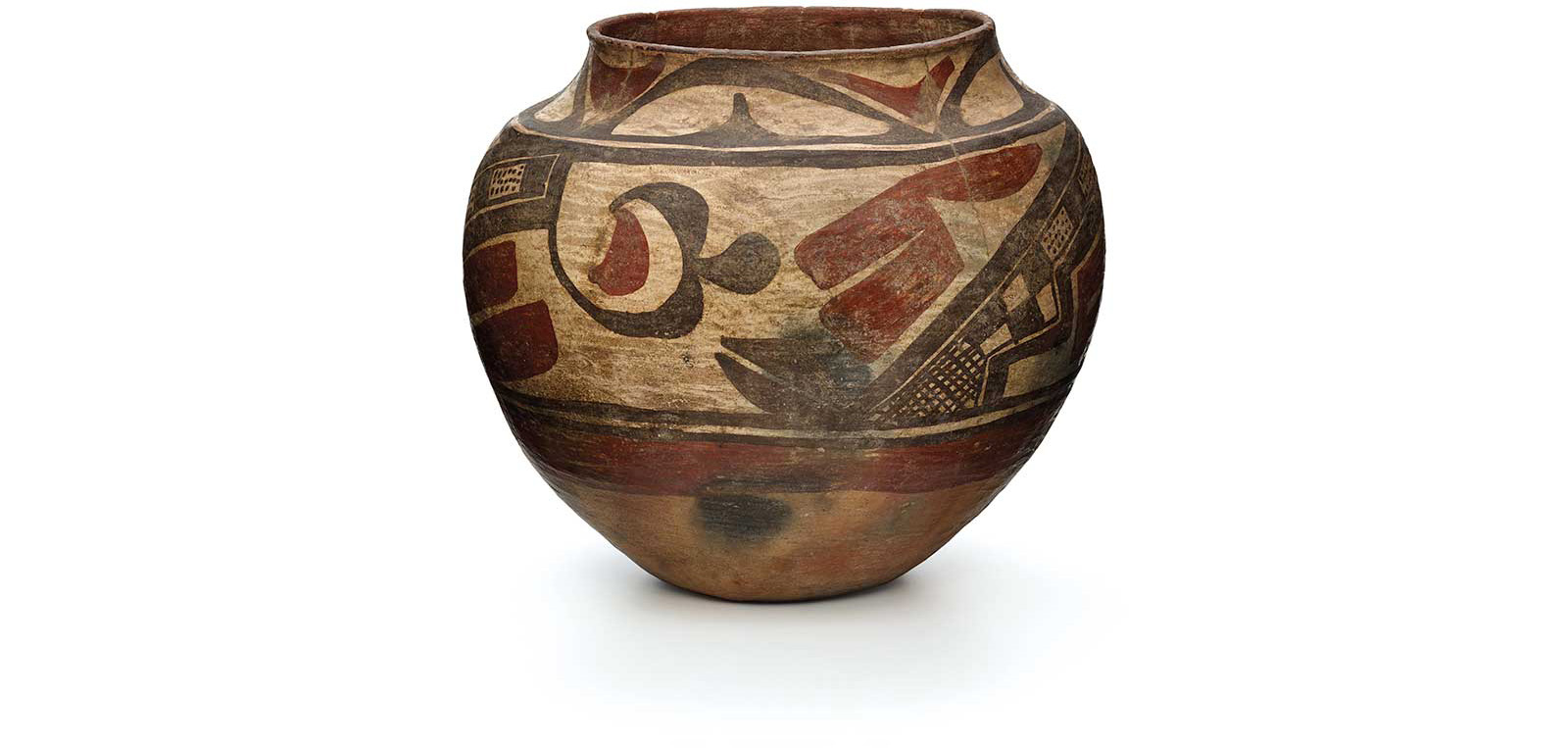 Santa Ana water jar, ca. 1895, clay and paint, 9½ x 11”. IAF.129.
While it might seem apparent that Pueblo community members are best suited to write about their own material culture, within the museum field and academia more broadly, Pueblo voices have largely been excluded. Instead, Pueblo pottery has often been presented “as ethnographic remnants of the archaeological past or as fine art examples aligned with milestones in Western art history and culture.” Through this exhibition, the Pueblo Pottery Collective presents an entirely novel (to the non-Pueblo public) perspective that is grounded in ancestral memory, community-based knowledge and personal experience. Furthermore, it demonstrates the living legacy of Pueblo peoples.
The major themes of the exhibit are Utility (functionality in all senses whether it be spiritual, economic, or domestic, etc.), Elements (earth, fire, water, wind), Connections Through Time and Space (past, present, future), and Ancestors—all of which are evident in the catalog entries.
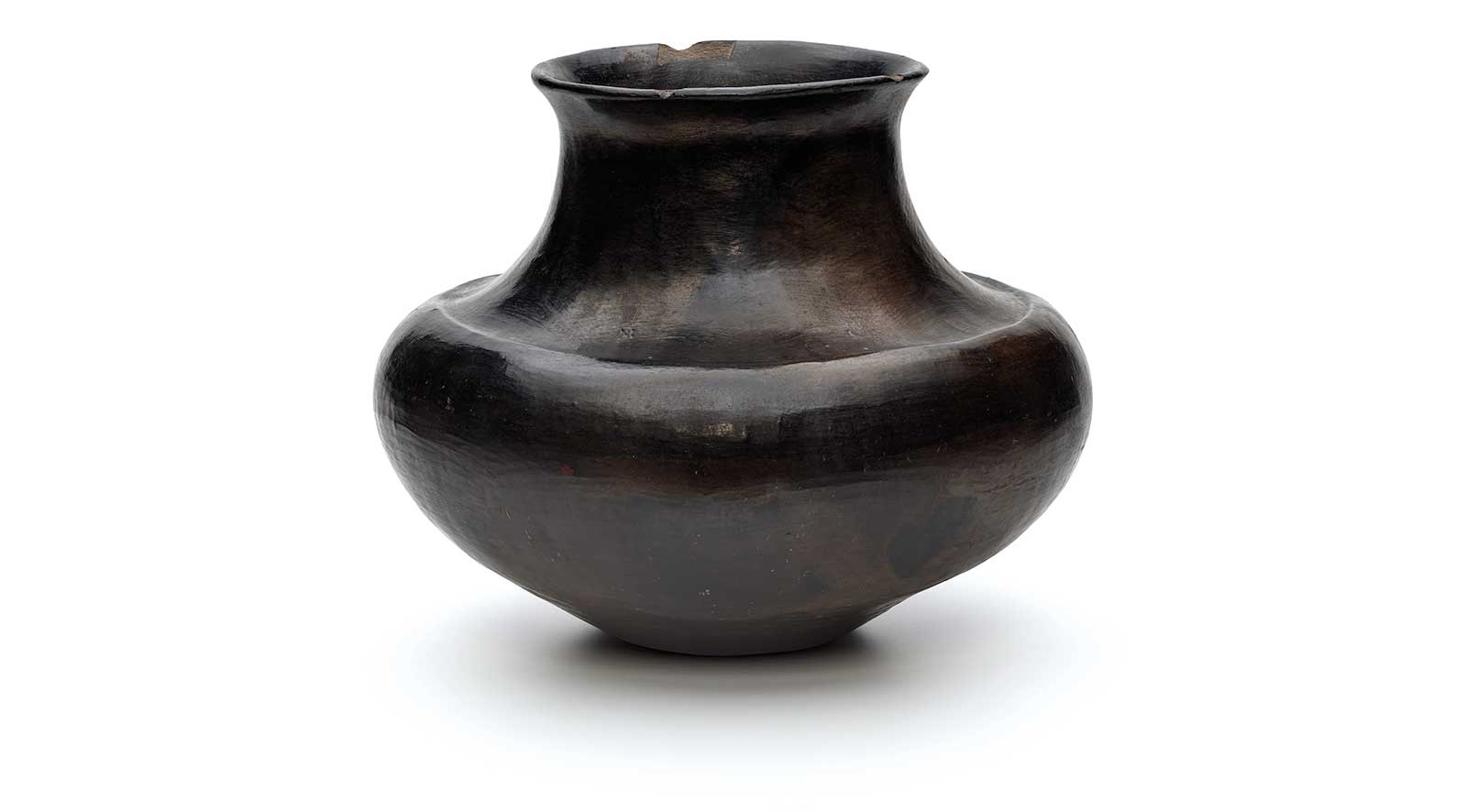 Kha’p’o Owingeh/Santa Clara Pueblo, water jar, ca. 1900
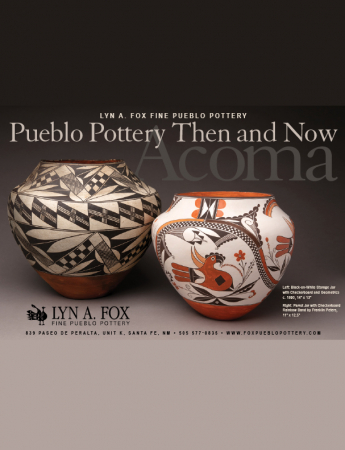
Haak’u/Acoma Pueblo Governor Brian Vallo reflects on several of these themes in his writing about a circa 1880 Acoma polychrome storage jar. “This jar sings loudly to me through its design and its lived experience at Acoma,” Vallo writes. “While it sits empty, absent of foods that sustain life at Acoma, it now is a visual feast for those who have the opportunity to experience its great prestige.”
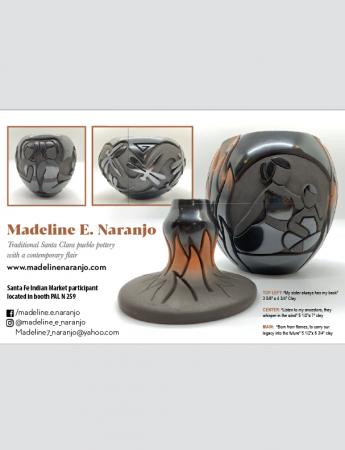
Similarly, Museum of Indian Arts & Culture curator Tony Chavarria writes of a circa 1900 stone-polished blackware olla from his home pueblo of Kha’p’o Owingeh/Santa Clara: “I see the flared collar and high neck in this jar. I see my grandma in the beauty from the earth.”
Kha’p’o Owingeh/Santa Clara Pueblo artist Rose Simpson muses on a water jar from around 1880 to 1900 from her home pueblo: “A form so intensely home. That neck, that shoulder. That toe stand. That brave shoulder.”
As illuminated by these excerpts from the Pueblo Pottery Collective, this exhibition emphasizes the significance of pottery and clay from both a communal and individual perspective. This sort of personal narrative is not something we typically see in museums. Exhibitions like this are really pushing the needle forward within the field and changing the way that Native art is presented within these spaces. Through this diverse collective of Native voices, we can see what is possible within these institutions when it comes to representing Native communities in a more honest, positive, and accurate way. Real change happens when Native people are provided a platform to tell our own stories.
“We really believed that by encouraging people to use their own voices and to talk about pottery in their own way–in a way that was very undirected, we would be able to uncover a different aspect of pottery that isn’t often talked about, and that’s exactly what happened,” says Elysia Poon, IARC director. “I think around here, everyone understands that pottery is really important to the Pueblo community and the very centering aspect that clay and pottery has in Pueblo cultures, but that aspect isn’t really ever talked about in a personal way. We really wanted to steer away from anything that could be considered sensitive or esoteric, and so we really encouraged people to dig deep into their personal memories and their hopes and dreams for the future and the catalog and exhibit were born.”
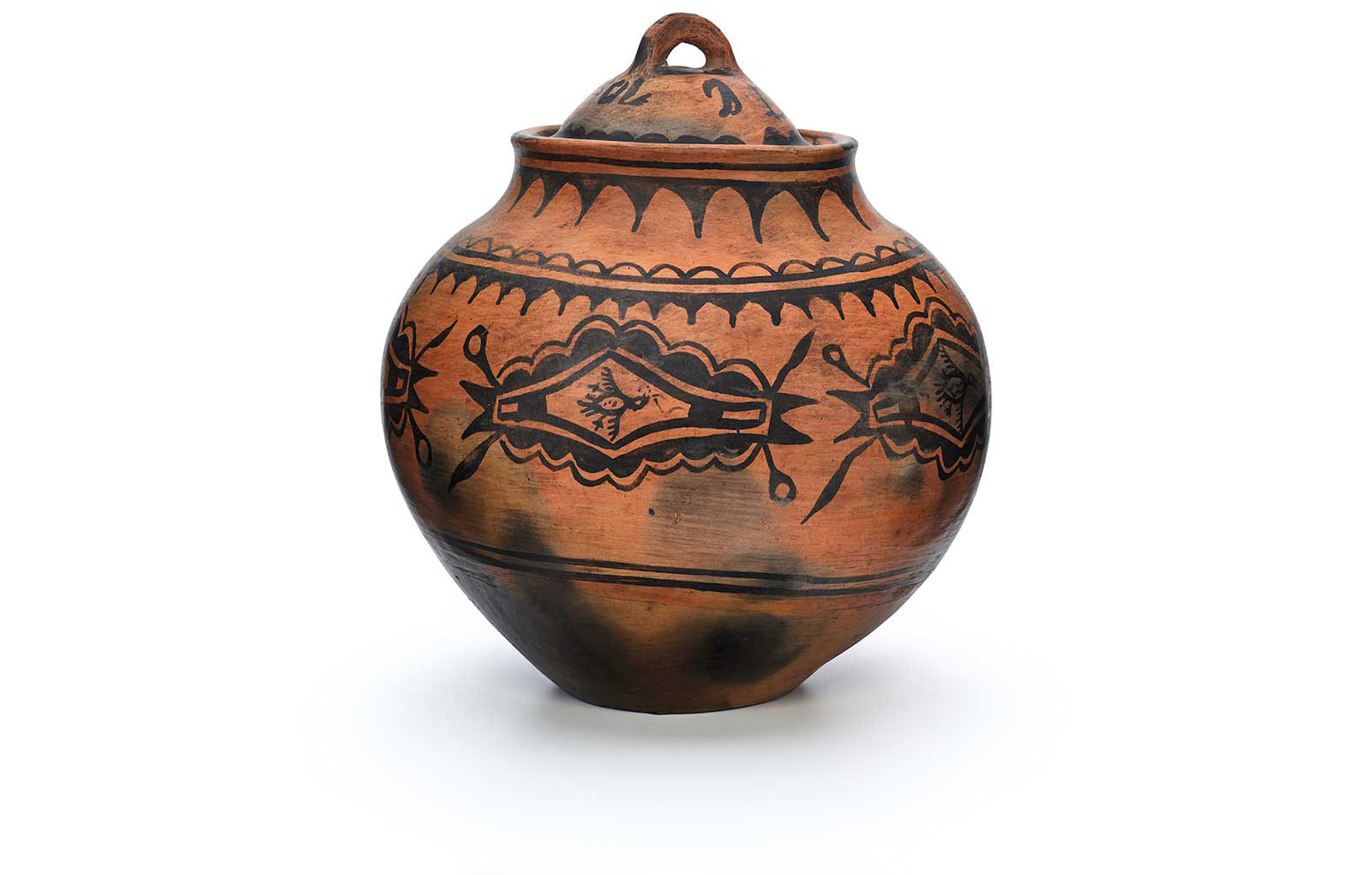 Marianita Roybal (San Ildefonso, ca. 1843), San Ildefonso black-on-red lidded jar, 12½ x 11” The Vilcek Foundation, VF2016.01.04. © The Vilcek Foundation.
This community-centered approach that prioritizes Native voices is not new to the IARC and, in fact, it aligns with years of work that has been done by the institution, most notably with the Guidelines for Collaboration. These guidelines, which are intended to serve as a resource for museums and communities planning and carrying out collaborative work, were developed over a three-year period of collaboration between Native and non-Native museum professionals, cultural leaders and artists. As explained by the SAR website: “These documents do not present a set of rules; instead, they offer principles and considerations for building successful collaborations.”
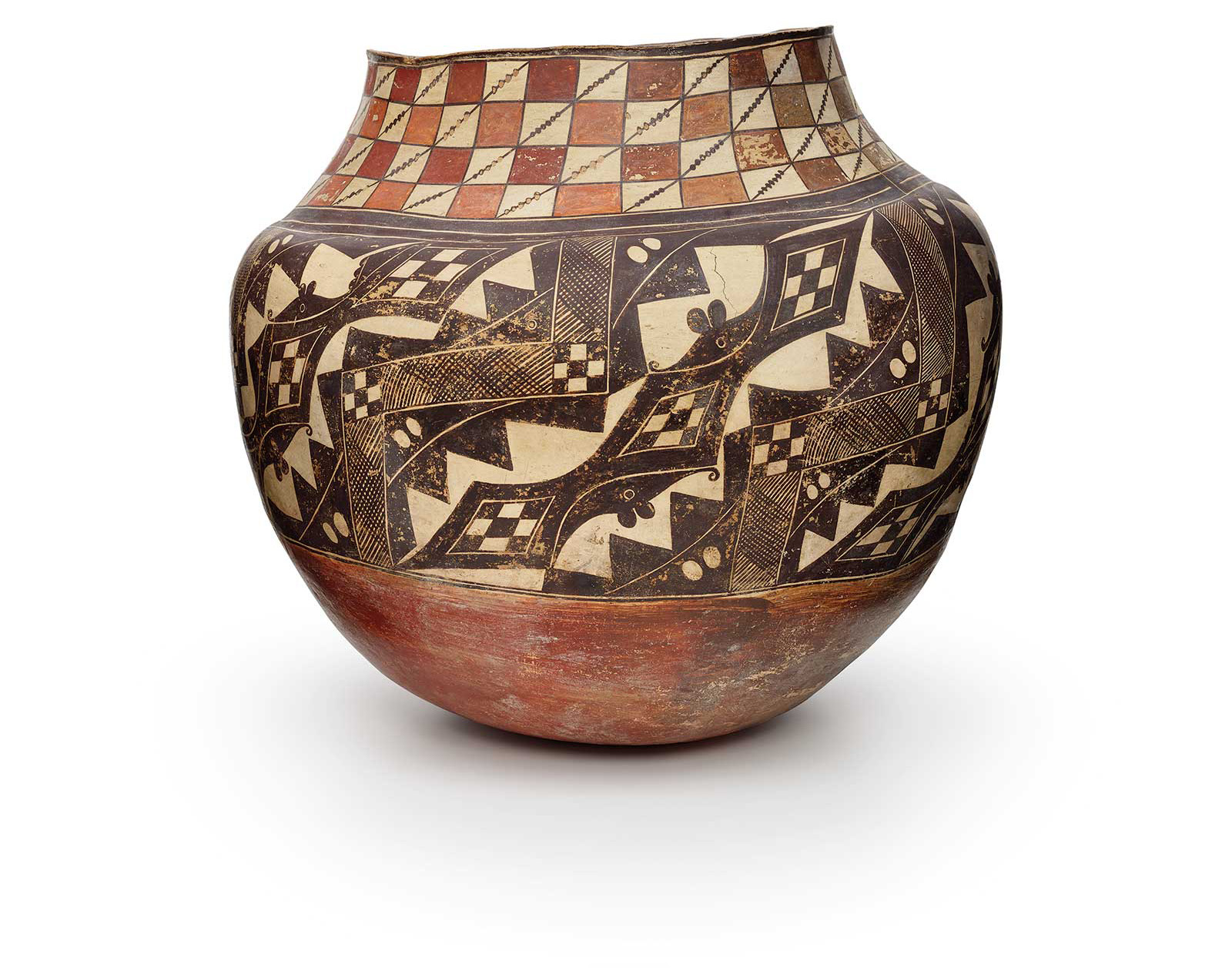 Haak’u/Acoma Pueblo, four-color polychrome storage jar, ca. 1880
This work has further expanded over the last several years into the development of the Core Standards for Museums with Native American Collections (CSMNAC), a comprehensive document for use by museums with Native collections for the purpose of clarifying their roles as stewards and ultimately to improve the museum field as it relates to Native American peoples, communities and cultural items. Poon explains that Grounded in Clay provides an opportunity to showcase the guidelines and core standards in practice. “We didn’t want to just have an exhibit and be done with it,” she says. “It was really important that the exhibit travel and that it travel to museums around the country—not just ethnographic museums, but art museums so that we could encourage this kind of collaborative approach.”
It is only fitting that this exhibition celebrates the 100th anniversary of the creation of SAR’s Indian Arts Research Center’s pottery collection in 1922.
Opens July 31, 2022
Grounded in Clay: The Spirit of Pueblo Pottery
School for Advanced Research,
660 Garcia Street, Santa Fe, NM 87505
(505) 954-7200, www.sarweb.org
Powered by Froala Editor